
How to Choose Your First Pickleball Paddle: Complete Beginner’s Buying Guide
Stepping onto a pickleball court for the first time is exhilarating, but choosing your first paddle can be overwhelming. With hundreds of options advertising raw carbon surfaces, polymer honeycomb cores, and varying grip circumferences, beginner players often struggle to identify what truly matters. Selecting the wrong paddle can hinder your skill development and lead to excessive arm fatigue. This comprehensive guide outlines the essential technical specifications every newcomer must evaluate before investing in their first setup.
Understanding Core Paddle Mechanics: Weight, Materials, and Shape
A pickleball paddle is not merely an oversized table tennis paddle. Its performance is governed by precise engineering standards established by governing bodies such as USA Pickleball. Understanding the relationship between static weight, face material, and core structure ensures you purchase equipment tailored to your current physical capabilities and athletic background.
1. Static Weight vs. Swing Weight
Static weight refers to how much the paddle weighs when placed on a digital gram scale, typically ranging from 7.0 to 8.5 ounces. Beginners must avoid overly heavy paddles that place unnecessary torque on the wrist and forearm tendons.
Lightweight Paddles (7.3 – 7.8 oz)
Lightweight options maximize hand speed at the kitchen line (Non-Volley Zone). They allow quick reaction volleys and reduce joint fatigue, making them ideal for players with previous wrist injuries or those transitioning from badminton.
Midweight Paddles (7.9 – 8.3 oz)
The universal baseline for 80% of recreational players. Midweight paddles deliver an optimal balance of baseline power and soft-game control without requiring heavy muscular exertion on deep returns.
2. Paddle Face Materials: Carbon Fiber, Fiberglass, and Wood
The outer surface determines ball dwell time, initial exit velocity, and spin generation. Modern paddles utilize composite materials engineered to deliver predictable rebound characteristics.
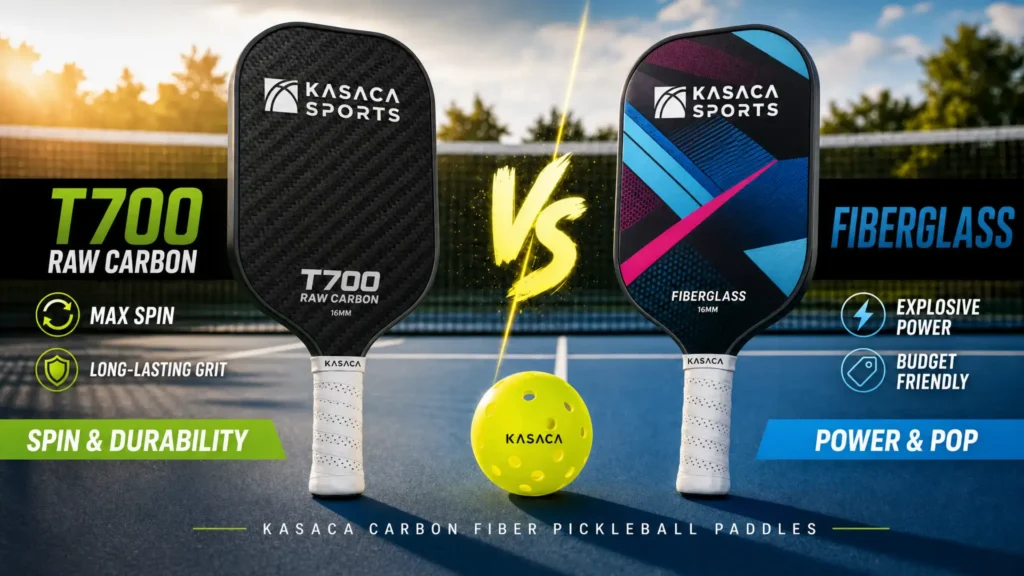
- Raw Carbon Fiber (Toray T700): Features a naturally textured micro-grit that grabs the ball plastic, imparting high spin rates while absorbing incoming pace.
- Fiberglass (Composite): Highly elastic. Acts like a trampoline, launching the ball with high exit velocity, but provides less control for short dinks.
- Wood: Outdated, heavy (>9.5 oz), and prone to dead spots. Generally reserved for budget institutional gym sets and discouraged for serious learners.
Beginner Paddle Comparison Matrix
The table below summarizes standard starter configurations, comparing entry-level fiberglass models against premium beginner carbon bundles such as the Kasaca Starter Lineup.
| Paddle Tier / Model Type | Face Material | Core Thickness | Avg. Weight | Primary Benefit | Sweet Spot Forgiveness |
|---|---|---|---|---|---|
| Basic Wooden Paddle | Multi-ply Wood | 10mm Solid | 9.5 – 11.0 oz | Ultra-low cost | Very Low (Center only) |
| Entry Fiberglass Starter | Printed Composite Glass | 13mm Polypropylene | 7.7 – 8.0 oz | High baseline pop | Moderate |
| Kasaca Beginner Carbon Setup | Toray T700 Raw Carbon | 16mm PP Honeycomb | 7.8 – 8.1 oz | Vibration damping & control | High (Edge-to-edge) |
| Junior / Youth Edition | Fiberglass Composite | 12mm Polypropylene | 7.0 – 7.3 oz | Small grip maneuverability | Moderate |
Grip Sizing and Ergonomics for Beginners
Using an improper grip size forces your hand to squeeze excessively tight, causing premature forearm fatigue and reducing touch sensitivity. Most adult players fit into a grip circumference between 4.125 inches (4 1/8″) and 4.25 inches (4 1/4″).
How to Measure Your Grip Size Accurately
- Extend your dominant playing hand flat with fingers closed together.
- Locate the bottom lateral crease across your palm.
- Use a standard ruler to measure the distance from that bottom palm crease up to the tip of your ring finger.
- If your measurement falls between sizes, always choose the smaller grip size; you can easily build it up using an overgrip wrap, but you cannot reduce a molded handle core.
Standalone Paddle vs. Complete 2-Paddle Starter Sets
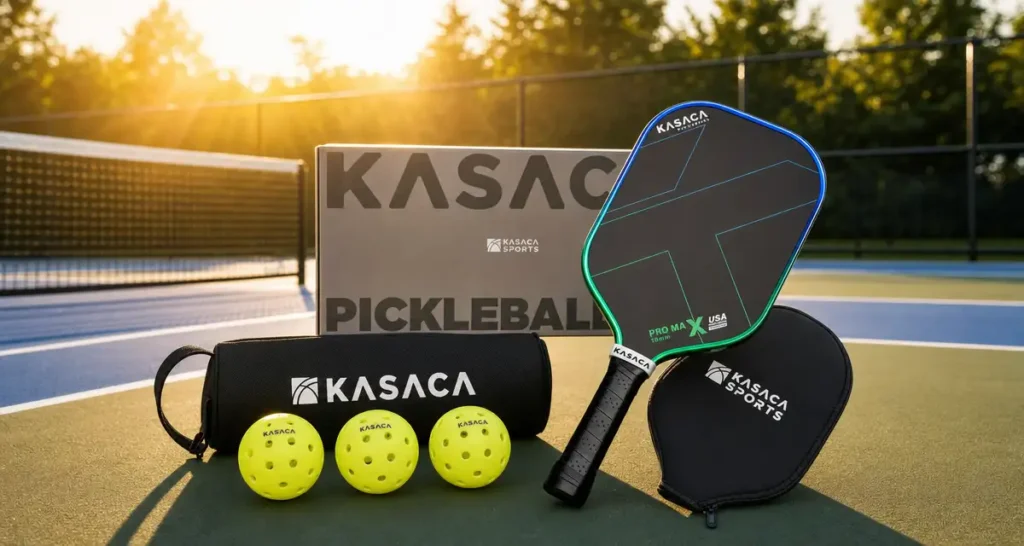
For individuals taking up the sport with a partner or spouse, a 2-paddle bundle provides unmatched practical value. High-quality starter sets—such as the Kasaca Pickleball Paddle Set—bundle two balanced paddles, four tournament-grade outdoor balls (40 holes), and an Oxford fabric carrying case. Buying bundled accessories reduces entry costs while guaranteeing matching equipment specs for cooperative drill practice.
Frequently Asked Questions (FAQ)
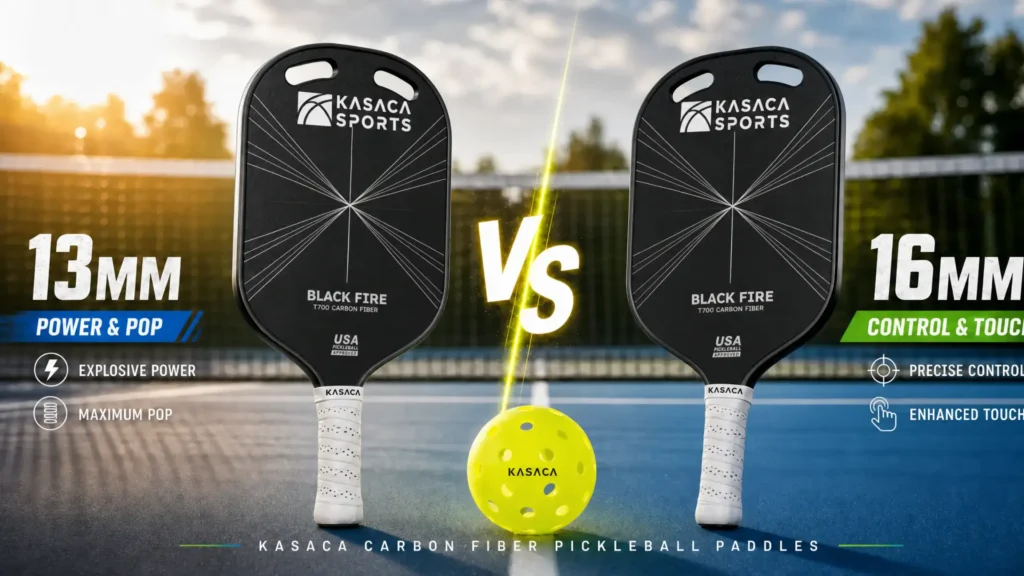
Should a beginner buy a 13mm or 16mm paddle first?
Beginners should almost always opt for a 16mm core. Thicker cores absorb excessive kinetic energy, reduce paddle twist on off-center hits, and provide the forgiveness required while developing soft-game resets and dinks.
How long does a quality beginner paddle last?
With regular recreational play (2–3 sessions per week), a premium polypropylene honeycomb paddle with a reinforced edge guard lasts between 12 to 24 months before experiencing core fatigue or surface grit wear.
References and Technical Sources
- USA Pickleball Equipment Standards Manual (ESM)
- Official USA Pickleball Rulebook & Specifications
- American Academy of Orthopaedic Surgeons (AAOS): Lateral Epicondylitis (Tennis Elbow) Clinical Overview
- ASTM International (ASTM C365/C365M): Standard Test Method for Flatwise Compressive Properties of Sandwich Cores
- ScienceDirect Engineering Topics: Mechanics and Energy Absorption of Sandwich Structures