
T700 Raw Carbon Fiber vs Fiberglass Paddles: Spin, Durability, and Arm Comfort Tested
The transition from basic composite paddles to advanced carbon surfaces represents the most significant technological leap in modern pickleball. Players shopping for mid-to-high-tier paddles invariably face a choice: stick with traditional fiberglass (composite) or upgrade to Toray T700 raw carbon fiber. Understanding the structural differences between these two surface materials is crucial for players seeking maximum topspin, long-term durability, and relief from joint strain.
Material Science: Toray T700 Carbon Fiber vs. Woven Fiberglass
While both materials are classified as fiber-reinforced polymers, their atomic structures and mechanical properties differ fundamentally in tensile modulus, density, and friction characteristics.
Toray T700 Raw Carbon Fiber Architecture
Toray T700 is an industrial-grade, polyacrylonitrile (PAN)-based carbon fiber recognized for high tensile strength (~4,900 MPa) and moderate modulus (~230 GPa). When utilized in “raw” unpainted form, the bidirectional weave of the carbon yarns remains exposed on the paddle face. This woven texture creates microscopic peaks and valleys that mechanically grip the surface of the ball, imparting friction-based spin without relying on topical spray-on grit.
E-Glass Fiberglass Construction
Fiberglass faces consist of woven silica-based glass filaments embedded in epoxy resins, often finished with screen-printed graphics and a clear polyurethane topcoat. Fiberglass possesses a substantially lower tensile modulus (~70 GPa) compared to carbon. This lower stiffness produces high elasticity, deflecting inward and snapping outward upon impact to generate exceptional kinetic energy at the cost of directional precision.
Performance Testing: Spin, Deflection, and Friction Wear
To evaluate how these material properties translate to court performance, standard laboratory tests evaluate surface roughness, spin generation via high-speed tracking cameras, and 180-day abrasion degradation.
| Technical Metric | Toray T700 Raw Carbon | Printed Fiberglass | Performance Advantage |
|---|---|---|---|
| Average Spin Generation (RPM) | 1,850 – 2,050 RPM | 1,300 – 1,500 RPM | Raw Carbon delivers +35% higher topspin / cut. |
| Surface Roughness ($Ra$) | 32 – 38 $\mu m$ (Uniform micro-texture) | 12 – 22 $\mu m$ (Smooth print layer) | T700 maximizes mechanical interlocking. |
| Grit Durability (180-Day Play Test) | >88% Texture Retention | <45% Retention (Spray grit wears off) | Raw Carbon maintains spin characteristics long-term. |
| Elastic Rebound Velocity | Predictable, linear response | High explosive bounce (“Hot spots”) | Fiberglass provides more raw power on drives. |
| Flexural Rigidity & Damping | High damping / Low harmonic ringing | Low damping / High vibration transfer | T700 absorbs shock, protecting arm joints. |
The Joint Health Perspective: Arm Comfort and Tennis Elbow
Vibration transmission is a primary contributor to lateral epicondylitis (tennis elbow) and wrist strain in racket sports athletes. When a ball strikes a paddle, high-frequency shock waves travel down the core through the handle into the player’s wrist extensor tendons.
Impulse Attenuation of Raw Carbon
The high tensile modulus of T700 carbon fiber acts as an acoustic and kinetic filter. Combined with a thermoformed structural edge and a polypropylene honeycomb core, raw carbon attenuates high-frequency peak vibrations within 25 milliseconds of contact. The result is a solid, muted sensation that minimizes microscopic tendon trauma.
The Harsh Feedback of Stiff Fiberglass
In contrast, fiberglass surfaces transmit sharp, high-amplitude vibrations directly into the arm, particularly when balls are struck near the edge guard. For players experiencing wrist weakness or recovering from elbow pain, stiff fiberglass paddles can exacerbate discomfort during extended drill sessions.
Durability Breakdown: The Truth About Surface Grit
A common complaint among competitive players is the loss of spin over time. On traditional fiberglass paddles, grit is applied via a topical quartz sand or polyurethane spray over the graphics. Within 8 to 12 weeks of intense slicing, this spray-on grit shears off, leaving a slick, smooth surface that struggles to generate rotational force.
Toray T700 raw carbon does not rely on spray-on coatings. The texture is an inherent characteristic of the carbon fiber weave itself, cured under high-temperature vacuum molding. Ball plastic residue will collect in the micro-grooves over time, but this can be restored to full spin capacity using a specialized natural rubber carbon cleaning block, extending the functional lifespan of the paddle to over a year.
Which Material Matches Your Tactical Profile?
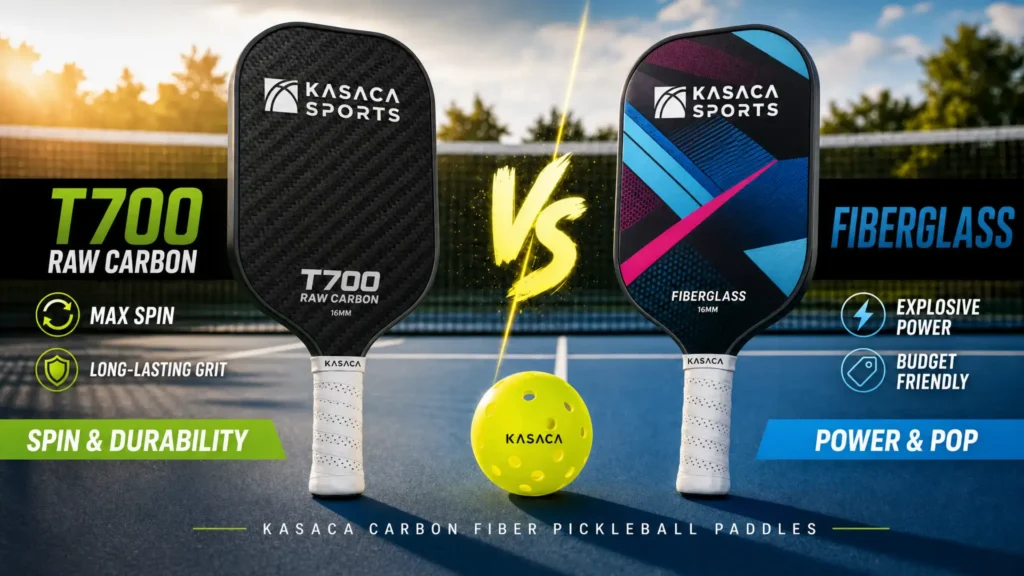
- Select Toray T700 Raw Carbon if: You rely on aggressive topspin dipping at opponents’ feet, prioritize consistent third-shot drops, demand equipment durability, or need maximum joint shock absorption.
- Select Fiberglass if: You are an entry-level recreational player on a strict budget who desires free power and pop without requiring advanced stroke mechanics to generate baseline depth.
References and Technical Sources
- USA Pickleball Equipment Standards Manual: Surface Roughness and Friction Specifications
- USA Pickleball Official Update: Dual-Camera Spin Rate Testing Protocols
- Toray Composite Materials America: Technical Data Sheet for T700 Carbon Fiber
- American Academy of Orthopaedic Surgeons: Biomechanics of Lateral Epicondylitis
- ScienceDirect Materials Science: Tensile Properties and Damping in CFRP Structures